Dr Saniya Khullar
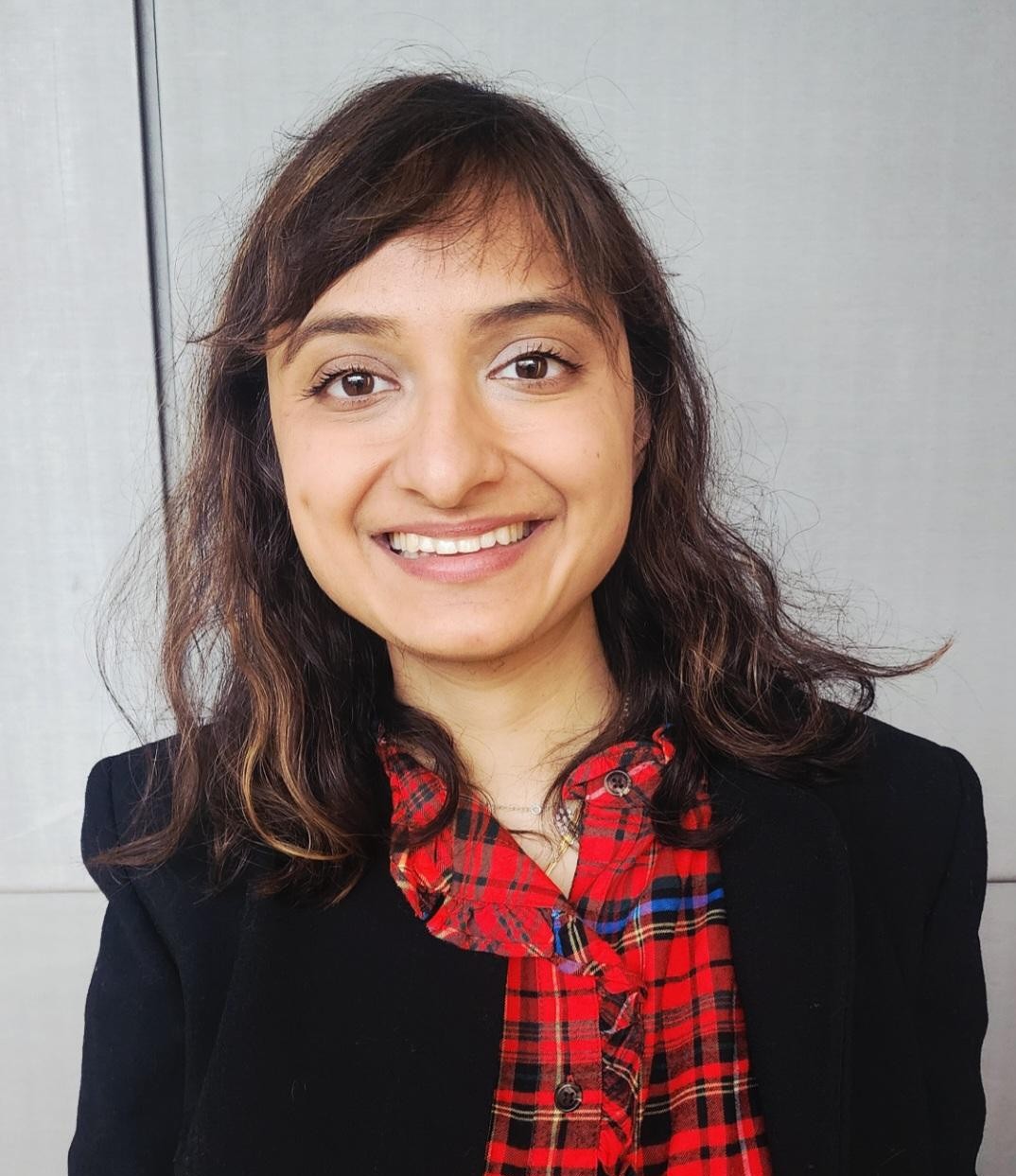
Dr Saniya Khullar is a Postdoctoral Research Fellow in Human Genetics at the Wellcome Sanger Institute and University of Cambridge. Her research focuses on immune-mediated diseases, integrating large-scale multi-omics data (genomics, proteomics, clinical) with advanced machine learning and statistical genetics methods. Her work seeks to uncover how genetic variation drives disease susceptibility, improve personalized genetic risk prediction, identify causal plasma proteins and molecular pathways as promising therapeutic targets. Through this translational framework, Saniya aims to accelerate precision medicine by transforming complex genetic and protein-level insights into actionable strategies for individualized patient care.
She holds a Bachelor’s degree in Economics (Honours) and Mathematics, with a minor in Business Administration, and a Master’s degree in Mathematics/Statistics from Georgetown University in Washington, D.C. Following graduation, she worked as a data scientist along the U.S. East Coast.
Saniya later earned a Master’s degree in Computer Science and a PhD in Biomedical Data Science from the University of Wisconsin–Madison. She was a predoctoral fellow in the highly-selective Computation and Informatics in Biology and Medicine program, dedicated to advancing precision biomedicine, and affiliated with the renowned Waisman Center for brain-related research. During her PhD, she developed two open-source computational tools (SNPheno, NetREm), which integrate genetics, multi-omics data, and systems/network biology to elucidate regulatory mechanisms linking genotype to phenotype. SNPheno identified candidate neuroinflammatory biomarkers. NetREm—presented at leading international conferences—is being widely-adopted by cutting-edge laboratories. She is a co-inventor on a patent for COVID-19 antibodies and contributed to large collaborative neuroscience consortia.
After her PhD, Saniya helped develop innovative single-cell analysis tools at Seattle’s Allen Institute for Brain Science. In 2025, she relocated from the United States to Cambridge, United Kingdom.
Beyond research, Saniya is committed to mentorship, humanitarian engagement, and outreach. She is a cat mom to Tubby and Chia.
Select publications
- Chirag Gupta, Noah Cohen Kalafut, Declan Clarke, Jerome J. Choi, Kalpana Hanthanan Arachchilage, Saniya Khullar, Yan Xia, Xiao Zhou, Mark Gerstein*, Daifeng Wang*, Network-based drug repurposing for psychiatric disorders using single-cell genomics, Cell Genomics, 2025.
- Saniya Khullar, Xiang Huang, Raghu Ramesh, John Svaren, Daifeng Wang*, NetREm: Network Regression Embeddings reveal cell-type transcription factor coordination for gene regulation, Bioinformatics Advances, 2024.
- Pramod Bharadwaj Chandrashekar, Sayali Alatkar, Jiebiao Wang, Gabriel E. Hoffman, Chenfeng He, Ting Jin, Saniya Khullar, Jaroslav Bendl, John F. Fullard, Panagiotis Roussos, Daifeng Wang*, DeepGAMI: Deep biologically guided auxiliary learning for multimodal integration and imputation to improve phenotype prediction, Genome Medicine, 2023.
- Minjie Shen, Carissa L Sirois, Meng Li, Yu Guo, Qiping Dong, Natasha Mendez-Albelo, Yu Gao, Saniya Khullar, Lee Kissel, Jonathan Bryan#, Soraya O Sandoval, Natalie Wolkoff, Amaya Contractor, Sabrina Huang, Tomer Korabelnikov, Birth Defects Research Laboratory BDRL, Jon Levine, Andre M.M. Sousa, Qiang Chang, Anita Bhattacharyya, Daifeng Wang, Donna Werling, Xinyu Zhao*, Species-specific FMRP regulation of RACK1 is critical for prenatal cortical development, Neuron, 2023.
- Saniya Khullar, Daifeng Wang*, Predicting brain-regional gene regulatory networks from multi-omics for Alzheimer’s disease phenotypes and Covid-19 severity, Human Molecular Genetics, 2023.
- Chirag Gupta, Jielin Xu, Ting Jin, Saniya Khullar, Xiaoyu Liu, Sayali Alatkar, Feixiong Cheng, Daifeng Wang*, Single-cell network biology characterizes cell-type gene regulation for drug repurposing and phenotype prediction in Alzheimer’s disease, PLOS Computational Biology, (Cover image of July 2022 issue), 2022.
- Chirag Gupta, Pramod Chandrashekar, Chenfeng He, Ting Jin, Saniya Khullar, Qiang Chang, Daifeng Wang*, Bringing artificial intelligence to research on intellectual and developmental disabilities: taking inspiration from neurological diseases, IDDRC 2022 special issue: Computational Neuroscience, Journal of Neurodevelopmental Disorders, 2022.
- Anna S. Heffron, Sean J. McIlwain, Maya F. Amjadi, David A. Baker, Saniya Khullar, Tammy Armbrust, Peter J. Halfmann, Yoshihiro Kawaoka, Ajay K. Sethi, Ann C. Palmenberg, Miriam A. Shelef, David H. O’Connor, Irene M. Ong*, The landscape of antibody binding in SARS-CoV-2 infection, PLOS Biology, 2021.
Select awards
- 2023 – Gold Medal (1st Place) Award for Focus Talk Presentation at the National Library of Medicine T15 Training Conference at Stanford University School of Medicine Department of Biomedical Data Science in Palo Alto, California, U.S.
- 2022 – University of Wisconsin – Madison’s Alzheimer’s Disease and Related Disorders Research Day (ADRD) in Madison, Wisconsin, U.S.: Lightning Speaker Award
- 2021 – University of Wisconsin – Madison’s Alzheimer’s Disease and Related Disorders Research Day (ADRD) in Madison, Wisconsin, U.S.: Fan Favorite Poster Award
- 2017 – Silver Presidential Volunteer Service Award awarded by the United States of America’s White House in recognition for outstanding dedication and devotion to community service for the nation. Participated in over 120 community service projects in New York in 2017.
- 2015 – Magna Cum Laude graduate (high academic distinction based on grade point average) with Honors in Economics from Georgetown University College of Arts and Sciences in Washington, D.C., U.S.
Further links
- Saniya’s Website: https://saniyakhullar.github.io
- GitHub: https://github.com/saniyakhullar
- Educational YouTube Channel: https://www.youtube.com/SaniyaKhullar
- Saniya’s Publications (Google Scholar): https://scholar.google.com/citations?user=2YXiDBkAAAAJ&hl=en
- Saniya’s ORCID Page: https://orcid.org/0000-0002-4166-874X