
Global Climate Research Prize unites world’s top universities in race for climate solutions
On the morning of Friday 8 May, Clare Hall and LUT University gathered at the British Embassy in Finland to announce the finalists for the inaugural Global Climate Research Prize, in the presence of distinguished representatives and dignitaries from the governments of Finland, UK, China, India, and Israel.
Researchers from the world’s leading universities entered the competition, with four finalists now in the running for the €200,000 prize at the award ceremony on 10 June at the University of Cambridge.
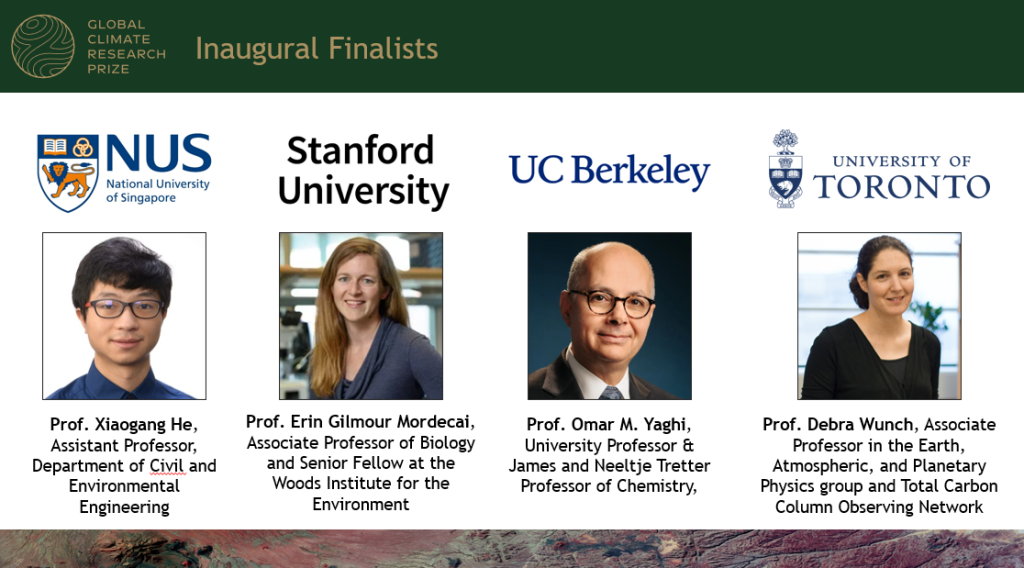
The shortlisted research teams are from the National University of Singapore, Stanford, UC Berkeley, and the University of Toronto, with projects tackling some of the most urgent challenges linked to climate change and global resilience: from using floodwaters to combat drought, to advancing greenhouse gas monitoring, developing solar-powered water technologies, and understanding how climate change is reshaping the spread of infectious diseases.
The winner will be announced at the ceremony hosted at the historic Cambridge Union Society, the oldest debating society in the world.
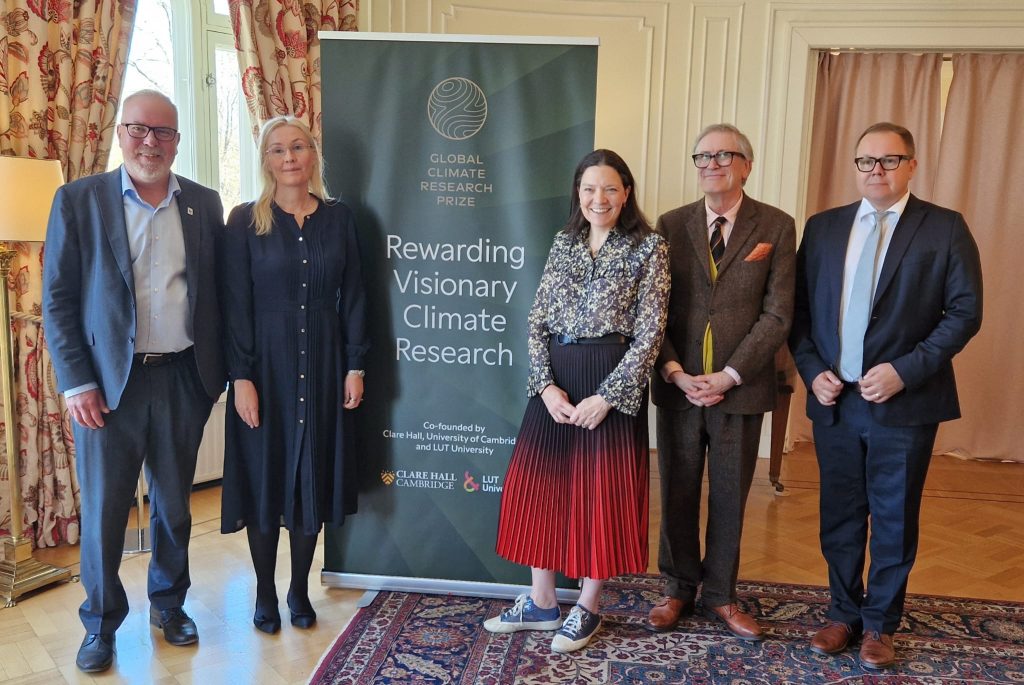

Founded by Clare Hall, University of Cambridge, and LUT University, Finland, the Global Climate Research Prize (GCRP) is a biennial environmental award supporting published, high-quality research with transformative and transboundary implications for addressing climate change. GCRP Member institutions include: ETH Zürich, Harvard University, Imperial College London, Nanyang Technological University, National University of Singapore, Peking University, Pontifical Catholic University of Chile, Stanford University, Tecnológico de Monterrey, Tsinghua University, UC Berkeley, UC San Francisco, University of Cape Town, University of Delhi, University of São Paulo, University of Tokyo, University of Toronto, Weizmann Institute of Science, and Yonsei University.
Former UK Astronomer Royal Professor Lord Martin Rees, Honorary Fellow of Clare Hall and former President of the Royal Society, said:
“The threat of catastrophic climate change creates an urgent need to develop innovative ideas for mitigating and adapting to this global emergency.”
Clare Hall and LUT University aim to establish the prize as one of the world’s leading platforms for climate research and international collaboration.
Professor Alan Short, President of Clare Hall, said:
“Our ambition is to develop this prize into a globally respected forum where leading researchers, thinkers, and policymakers come together to advance solutions to climate change.”
Finalists and short abstracts are listed below.
National University of Singapore
Assistant Professor Xiaogang He
“Storing floodwaters for periods of drought”
This research combines climate science, data analytics, and resilience frameworks to better understand and manage extreme weather events. Drawing on 67 years of global drought and flood data, the work has shown how droughts and floods increasingly occur in rapid succession, threatening food and water security. The findings have informed managed aquifer recharge solutions now applied worldwide, using floodwaters to strengthen drought resilience and groundwater supplies.
Total Carbon Column Observing Network (TCCON) / University of Toronto
Professor Debra Wunch, Dr Nicholas Deutscher, Dr Joshua L. Laughner, Dr Thorsten Warneke, Dr Paul O. Wennberg
“How much greenhouse gas is actually in the atmosphere?”
TCCON is a global network of measurement stations combining ground-based observations with satellite data to provide highly accurate monitoring of greenhouse gases in the atmosphere. The research supports the study of atmospheric change and carbon cycles, while also helping validate climate models and emissions tracking as global monitoring efforts become increasingly important.
University of California, Berkeley
Professor and Nobel Laureate Omar Yaghi
“New materials that can harvest water using solar energy”
This research pioneers advanced materials capable of capturing water from desert air using solar energy, while also enabling carbon dioxide capture, hydrogen storage, and clean fuel technologies. Combining chemistry, engineering, and environmental science, the work has transformed materials design through the field of reticular chemistry and advanced practical technologies for clean water and energy solutions.
Stanford University
Professor Erin Gilmour Mordecai
“How does climate change affect the spread of infectious diseases?”
This research examines how climate change is altering the spread and evolution of infectious diseases, particularly those transmitted by mosquitoes and ticks. The work has shown how rising temperatures influence diseases such as dengue, malaria, West Nile fever, and Lyme disease, improving understanding of emerging global health risks in a warming climate.